Pools By Trinity
My first paid project: a website for a local pool company.
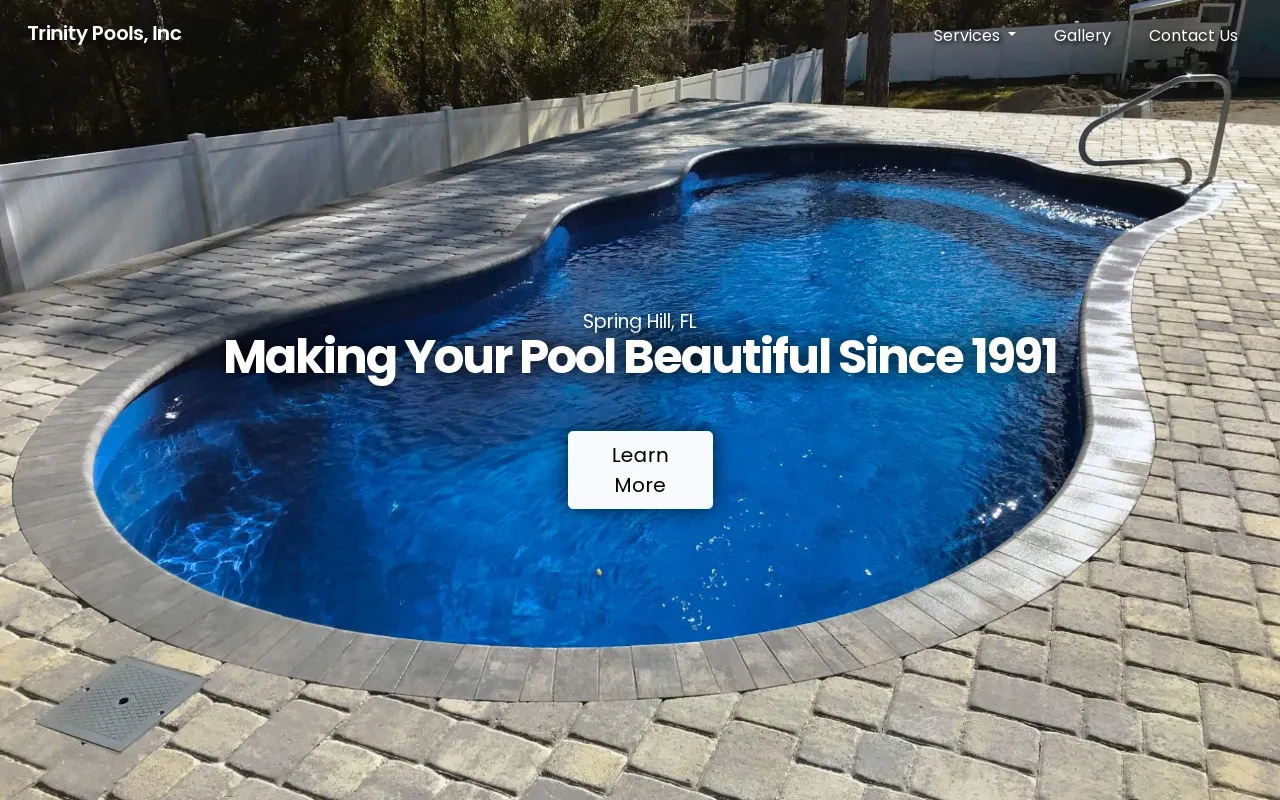
This was the first paid project I did, for Trinity Pools, a family-owned pool company in Spring Hill, Florida that has been building and servicing pools since 1991. They needed a simple, good-looking site that told people what they do and made it easy to get in touch.
What’s on the site?
A clear first impression. The home page opens with a full-width photo of a finished pool, the company’s tagline, and a “Learn More” button that scrolls to the about section.
One page per service. Concrete pools, fiberglass pools, pool and deck remodeling, and maintenance and service each get their own page, reached from a dropdown in the navigation.
A photo gallery. Photos of past work open in a lightbox, since for a pool company the finished work is the best sales pitch.
Contact details up front. The contact page lists the address, phone number, email, and hours.
What was challenging?
Replacing a bloated template. I first built the site from a ready-made HTML template. It looked fine but shipped far more CSS and JavaScript than a handful of pages needed, and it was slow. Shortly after, I rebuilt it in Bootstrap Studio, keeping only what the site actually uses.
Being the first client. This was my first time working with a real business owner, so I learned to turn “make it look nice” into concrete decisions about pages, photos, and wording.
How was it built?
The site is plain HTML and CSS built with Bootstrap Studio and Bootstrap 5, with small touches like fade-in animations and the gallery lightbox. It has no framework or build step. The link above is an archive of the site, not the original hosting.
How fast is it?
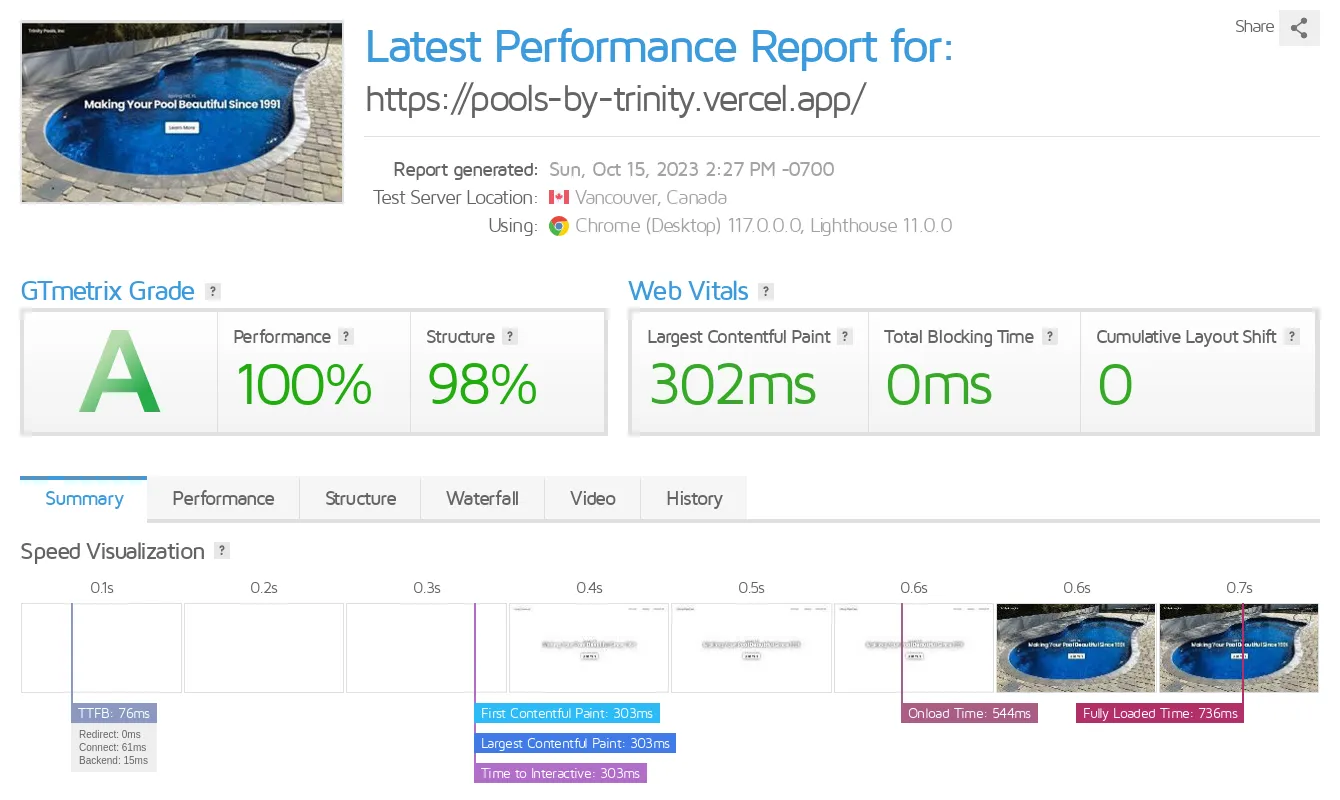
I ran the archived copy through GTmetrix. It scores an A, with 100% for performance and 98% for structure. Largest contentful paint is 302ms, total blocking time is 0ms, and there is no layout shift.
What would I change next time?
Looking back at the archive after building Lot Legends, the site scores well on speed but misses a lot of the fundamentals I now build in from the start.
Compress images at build time. The gallery loads twelve full-size photos, up to 660KB each and roughly 3MB in total. They’re used both as thumbnails and in the lightbox, with no lazy loading. The hero image is 563KB and the social preview image is 359KB. On my newer sites, Astro Assets resizes every image to what each screen needs and re-encodes it, so this would be a fraction of the size.
Give every page its own title and description. All seven pages share the same title (“Trinity Pools, Inc”) and the same meta description. A concrete pool page and a maintenance page should each say what they are, since that’s what shows up in search results. I’d also add LocalBusiness structured data, like on Lot Legends, so search engines know the business’s location and hours.
Fix the accessibility basics. None of the 16 images has alt text, and each page has two or three h1 headings instead of one. I now treat these as part of the build, not as a cleanup pass, as I did on King of Hearts.
Make the contact page do more. It’s just a block of text. The phone number isn’t a tappable tel: link, there’s no map, and there’s no quote form. Lot Legends is built around its form, and a pool company would benefit from the same thing: the easiest path from “I want a pool” to a request for a quote.
Load fewer third-party files. The site pulls in Bootstrap, Font Awesome 4.7, animate.css, AOS, baguetteBox, and two Google Fonts families from CDNs, and each of those is another request. Fonts would be self-hosted, and the few icons and animations it uses would be plain CSS or inline SVG.
Clean up the SEO files. The sitemap lists the 404 page, and there’s no robots.txt. Astro generates a correct sitemap automatically.
Move past a visual editor. Bootstrap Studio was a good fit for a first project: I could design visually and export clean static files. But what it exports is plain HTML, so the navigation and footer are repeated in all seven files. Any change made outside the editor, like editing this archive, means seven identical edits. Now I’d build it in Astro, where a shared layout and components make that a one-line change, the gallery is a simple list of images, and the build handles image compression and per-page titles for me.
Even with that list, I’m still proud of this one. It was my first real client, and it got a family business online with a fast site they could be happy with. Most of what I’d change now is stuff I only learned by building the projects that came after it.
